Thursday, May 11, 2017

DEMOLISH OR KEEP?

Many people have the dilemma of whether to keep Mr Lee Kuan Yew's house or not. To some, they feel that respecting the last wishes of their nations fore father is better and that the should demolish the house. However, to the tourism board, it might seem that Mr Lee Kuan Yew's house might bring economy to the country by keeping it as a heritage sight for tourist to visit. Whereas historians will keep it for heritage purposes and use it as a history source for Singapore.

In my opinion, I feel that demolishing it is the best option. Although keeping it has many benefits, I find disrespecting Mr Lee's last wishes is unacceptable as following his wishes is the last form of respect one could give to our late fore father. I also find that keeping it to earn money is extremely disrespectful as Mr Lee would not want people coming into his house and not follow his last wishes before he left.

In conclusion, I feel that we should demolish Mr Lee Kuan Yew's house and respect his last wishes.

Sunday, April 30, 2017

Money or the Environment?

The dilemma of protecting the environment and increasing our economy is hard sometimes. In the government's perspective, the economy might be more important as a growing economy prevents the country from falling behind other countries in terms of economy. The environment might mean very less to the government as it does nothing good to them. They only want to use materials from the environment to make money and money is the greatest priority. However the environment is also very important to show an image of the country, and it also helps preserve many different species of flowers and fauna which might be endangered. Hence, I feel that it is both important to protect the environment and to increase our economy. Both should be done equally and a balance should be maintained while trying to increase the economy and protect the environment at the same time. Don't excessively get land to build infrastructure or excessively use the materials such as wood to build products. Also, the government should also be mindful of the limit of keeping the environment, both economy and the environment are important so doing it equally will help the country prosper and have a nice and clean environment.

Saturday, April 1, 2017

Consequences of high cost of living in Singapore

Singapore is a very developed first-world country. Despite being a small island, we have many skyscrapers, industrial buildings and tourist attractions around here. We are lucky to have basic services, security and education. However, the cost of living in Singapore is very expensive. Something we buy here in Singapore can be easily two times more expensive than in other countries. For example a big mac in Singapore costs $4.70 whereas in China it costs about $2.50. Owning a car  in Singapore is also very expensive and it could easily cost up to $100 000 or more.

However, these high costs of living can result in both positive and negative results. One positive result can be that the high cost of a car in Singapore can result in lesser people buying cars and reducing air pollution, saving the earth. However, with daily necessities also becoming so expensive, the birth rate might be lower as having kids would be to expensive to raise, especially now that going to universities can be very expensive.

Sunday, March 26, 2017

Reflection ENC Week :D

My feelings about the trip:

The trips to Kampong Glam, Little India and Kampong glam were very fun and enriching at the same time. I got to learn about the culture and I learnt so much new things I never knew.

Kampong Glam:

On the first day of the learning journey, we went to Kampong Glam. We were allowed to roam around the streets and try out their amazing traditional Malay food. When I went there, I ate Nasi Lemak, a traditional Malay dish. It contains of very fragrant coconut rice with ikan billis, a fried egg and a fried chicken wing. It is really delicious and the chilli they give, tastes really good with the dish. While walking around the streets of Kampong Glam, we saw a man eating some really interesting looking Malay dish, so we decided to ask him what he was eating. He was very kind to tell us the different type of Malay dishes and the type of spices they use. It seemed like the Malay cuisine is actually a fusion of different cuisines. I never knew that until I went for this learning journey.

The next day we went to the sultan mosque. There was a tour guide who told us the different features of the mosque. He said that the black ring around the base of the golden dome was actually glass bottles that were donated by the poor as a contribution to the mosque. It is really amazing to see how they thought of ideas of letting the poor contribute and do a part. 


We went to the Madrasah school later that day and we got to see how a Islamic school is. We were also introduced to what they learn. It is really astonishing to see the number of subjects they have to learn and it is much more than what we have to learn. They also sang their prayers and introduced traditional Malay instruments which even had a chance to play. It was super fun and very interesting.

Little India:

On the last day, we went to little india and we explored Tekka market and we saw a lot of different clothes and food. We tried the indian rojak and we realised how it was similar to Singapore, there were many different fruits and flavours, just like Singapore with many different races. I also went to try henna, a special paste that is applied to the skin to leave temporary dark marks. It is normally drawn as really pretty floral designs and it looks amazing. While walking pass a dessert shop, I asked the owner if there was a reason why their food are sweet. He told me that it meant prosperity to them so they eat it.

Overall reflection:

I was really glad to go on this trip as I found out a lot of information I never knew about this culture before and it was really fun and enriching. I wish to have more trips like this!





Saturday, March 4, 2017

The Economy part 1


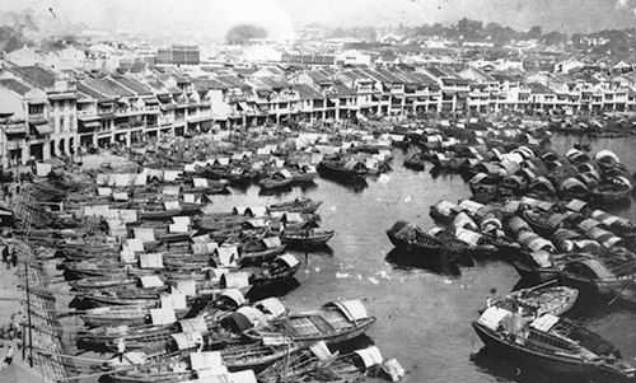
This was the old Singapore river. Dirty, polluted, overcrowded with boats and packed with houses on the shore.


This is the current Singapore river. Clear blue water with a few ferries. Industrial buildings and houses all around it.

Singapore has changed so much from 50 over years ago. Growing from a 3rd world to a 1st world country almost everything changed. Its economy too.

It was not easy for us to turn from a third world country to a first country world in a short span of 50 years. It took a lot of hard work and effort to do so.

We should not be complacent as there are many big countries like USA and China who can easily take over us. They have more land, resources and man power than us. A project that they can take merely 5 years to do, Singapore will probably take double the time. Compared to other developed countries, we are just like a small island which can be easily overtook.

If we do not have a good relationship with China, whenever we have problems like lack of resources, we will have a hard time finding another country that will be willing to help us.

Hence, we should not be complacent and our relationship with China is very important for us.


The "C" word


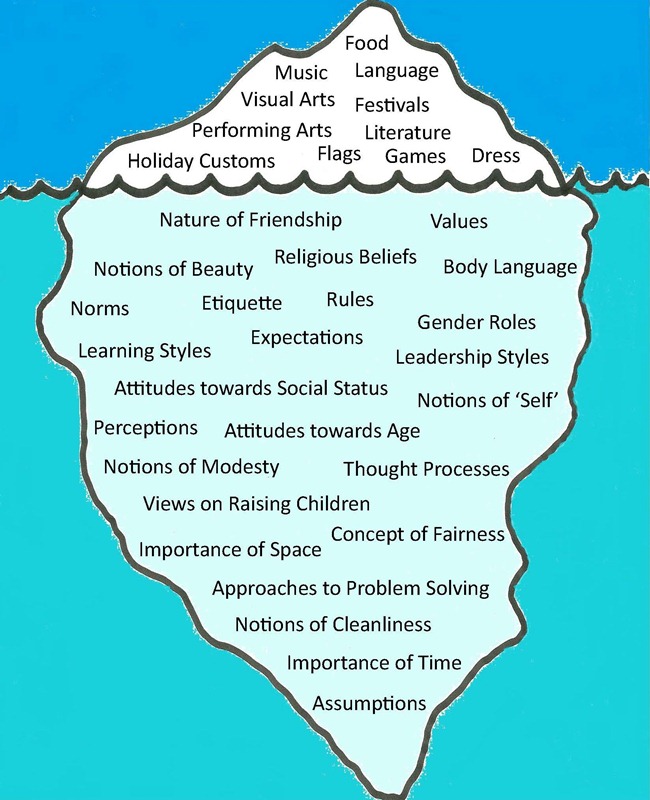
The iceberg model

This model describes the hidden part of cultures we do not see, and the visible ones. From the picture, we can see that food, music language and games are visible to us and it is very obvious and we can know what type of cultural food or music just by clicking onto youtube and searching for it. However we cannot clearly things like their values or body language just by watching a video. We have to interact with the people and experience their lives to know the actual full culture

Singapore's culture

Whenever someone thinks about Singapore, they would probably think of the word "Singlish" or "kiasu". We Singaporeans love to compete with other and use improper English. This is probably why foreigners think of this two words as soon as they hear the word Singapore. However, this is just the surface of our culture, we have more on the inside where people cannot just point out easily. They think that Singaporeans are "kiasu" as they are afraid of losing and not winning. However from my point of view, we are "kiasu" as the society out there is harsh and if we do not buck up and not compete to be the best, we will probably not be able to get a decent job in this fast paced world. So, I am just trying to say that the inside of a culture needs patience and detailed viewing to find and learn about it. There is so many things hidden that we need to find out patiently.


Friday, February 3, 2017

WELCOME TO BEIJING

 
Aspect of Chinese culture
Description of scene from Video
How does the scene demonstrate Chinese culture
Calligraphy
1.     Singer writing calligraphy and showing it
2.     There was a ” ” hanging upside down
·         It was how people living in ancient China wrote and it was their way of communicating.
·         Hey used calligraphy writing for decoration purposes. Example the word “ “ which is normally hung at peoples’ houses during Chinese New Year.
 Porcelain pottery
Different type of porcelain pots on the shelves with various designs
·         In the past traders would go to China to get porcelain and it was a very valuable item back then in the period of the ancient China
·         The westerners always admired the way the porcelain potteries look
·          When people think about porcelain potteries they will think of China as there is where good qualities porcelain potteries are made
Shadow puppet performance
1.       Singers and an old lady playing with the puppets  
2.       Puppets behind the screen moving around
·         It was used in the past as a form of entertainment
·         It originated from China thousands of years ago

I feel that these 3 parts are the most significant demonstrating Chinese culture and it shows how the culture was formed.

CHINGAY Reflection

Chingay reflection

That day was the first time I had ever saw a full Chingay parade. It was just amazing and an eye opener to me. I saw different types of performances and different people working together to bring to us a spectacular performance that we will never forget. I saw determination and passion in the performers. That day, it was pouring. All of us had to wear ponchos. At first we were all complaining how unlucky we were and how stupid this trip was. However I changed my mindset when the performance started. The children who were performing were just primary school kids and they still did their best in performing despite the heavy rain. It made me think why was I so rigid with my thinking and why was I complaining when I could sit and enjoy a performance while kids younger than me had to perform in such bad conditions. It had made me look at a different side of thinking and made me feel more grateful to what I have.

Taken from Facebook page of Chingay 2017

The purpose of Chingay

Chingay's purpose is to compensate the ban of firecrackers. And I feel that it did better than compensating for it. To me, it also showed Singapore's multiracial society.

 I could see the multiracial country I know of in the performance "friends around the world". I could see many different people from different races performing and putting on a spectacular performance. The performance showed me the different cultures of the different countries such as Japan, South  Korea and Indonesia .

Taken from chingay.org 3rd segment event highlights
Apart from the spectacular performances, there were floats showing cultures of different countries such as the Japanese drum float and the PA water venture float. They were bright and vibrant in colour.


PA water venture float


Japanese drum float


I found that chingay has fulfilled it's purpose as I saw the multiracial nation that we are known for and it definitely brought smiles to our faces as much as playing with firecrackers. In fact it did not only enriched me with new knowledge of the culture of different nations, it also made me have a fun time with my fellow friends and classmates, eating and watching the parade under the rain. The fireworks at the end  
was probably one of my favourite and it made me feel as much fun as I would have playing with firecrackers.


Monday, January 30, 2017

Forces of culture

What are forces of culture?

Forces of culture are events that happened which helped to shape the culture we know of now. History. China's culture was not there since the start of the Chinese civilisation, but it was shaped through events that happened during the time of Ancient China. One example could be the using of chopsticks. The older generations who are more traditional often insist that we later generations should know how to use the chopsticks as we are Chinese. But have we ever wondered why is that so? Did we ever wonder that it could be due to our traditions or cultures? Or why is that tradition and habit so important.

Why do I think history is one of the forces?

History to me is a series of events that happened in the past. I feel that history is one of the forces because some of the cultures present now are caused by events that happened in the past. Using the first example, the using of chopsticks. From what I know about chopsticks, they were first "invented" when two men were eating a bowl of hot porridge. The porridge was way too hot to be eaten by drinking from the bowl and at that time there were no inventions of utensils. So one of the guy picked up to broken sticks from the floor and tried to eat with it and they found that it was not as hard to consume. Apart from that, Confucius also felt that it would be inappropriate to have a knife on the eating table and that the food should be cut before it was cooked. So it seems that the chopsticks will be the best way to eat by grabbing morsels of the food to consume. This string of events led to the tradition of why the older generations insist us to use chopsticks. Hence I feel that history is one of the forces.

Picture that represents Singapore Culture


This picture shows the multiracial society of Singapore. We do not discriminate each other and we love each other regardless of race language or religion. We do treat each other fairly and we work and study together in harmony. This what I feel makes us Singaporeans and what people think when they think about this country, Singapore.


Thursday, January 12, 2017

Hi! I'm Wynnona from class 2D. I'm from netball and my hobbies are playing my guitar and playing basketball. Although I was never from a basketball CCA, I self taught myself how to play as I thought it was a really fun and cool sport. From the pictures I see and what my father had told me, I guessed I had loved the guitar instrument since I was very young.  I love to watch how talented guitarist play their guitar solos in the songs and how their hands were so quick to pick the strings and make really cool music. Something my friends find weird about me is that I prefer Chinese songs to English songs which to them seems like a very weird thing as most people now love listening to either English songs or Korean pop. Out of all the talented Chinese singers out there, my favourite is our local singer JJ Lin. He is a talented artist who I want to become like and he is the pride of our country. I also like to eat and my favourite food are probably steak and chicken dishes and I eat a lot I guess
I just demolish food like a dinosaur devouring its prey.


These is the table of my predictions and understanding of typical Singaporean and Chinese people.

That is all for my self introduction and hope you get to know a little bit more about me!